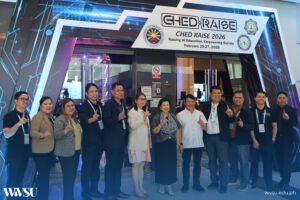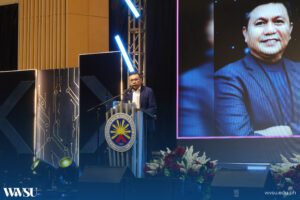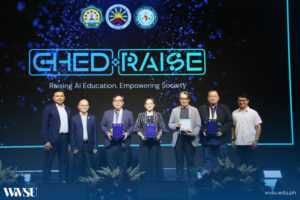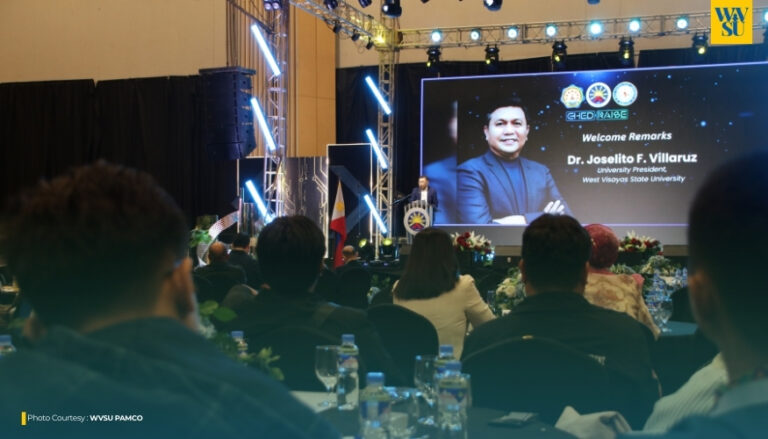
West Visayas State University (WVSU) President Dr. Joselito F. Villaruz opened the second day of the Commission on Higher Education (CHED) Responding through AI for Societal Empowerment (RAISE) 2026 national summit on Feb. 26, reaffirming WVSU’s commitment to responsible and inclusive artificial intelligence in higher education.
Held at the Iloilo Convention Center, the three-day CHED RAISE summit is headed by CHED, in partnership with Northern Iloilo State University (NISU) and WVSU. The event gathers university leaders, faculty members, students and industry partners to align academic programs with the demands of an AI-driven economy.
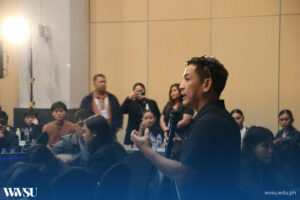
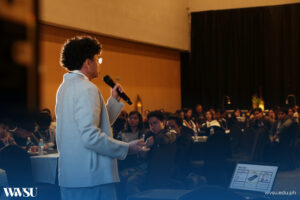
A key highlight of Day 2 was the plenary discussion “AI Requirements in the Industry,” which examined workforce competencies, infrastructure readiness and cross-sector collaboration needed to meet emerging industry standards. Panelists included Jonathan Defensor De Luzuriaga, president and CEO of Spring Valley Tech Corp.; Engr. Fulbert Woo, president of the Iloilo Chamber of Commerce and Industry; and Frankie Antolin, executive director of the IT and Business Process Association of the Philippines. The discussion was moderated by Jaime Noel Santos, president of Thames International Business School.
The session underscored the urgency of equipping graduates with AI, analytics and digital competencies that respond directly to industry needs — a message that carries direct implications for curriculum development, instruction and student preparation at WVSU.
Parallel breakout sessions provided sector-focused discussions for faculty members, administrators and students.
For teachers, Engr. Orland Tubola of the Polytechnic University of the Philippines led “AI for Cooperatives,” highlighting AI applications in cooperative management and community-based enterprises. In the afternoon, Dr. Jassiel Padios of Iloilo State University of Fisheries Science and Technology, delivered “Capacity Building on Fisheries AI-Mediated Technologies,” emphasizing AI applications in fisheries research and extension. Engr. Lester Phil Crus of Bulacan State University also presented the “Executive Program on Artificial Intelligence and Internet of Things for SUCs and LUCs (BulSU-HUSAY)”, outlining structured capacity-building initiatives for state and local universities and colleges.
For administrators, Samu Samson of International Business Machines Corp. led “Setting Up the Infrastructure for an AI Program,” focusing on institutional readiness and scalable implementation. Dr. Oliver Malabanan of De La Salle University discussed “Designing Curricula Aligned with the Philippine Skills Framework for Analytics and AI,” emphasizing outcomes-based alignment with national standards. Dr. Jaime D.L. Caro of Technofactors Inc. delivered “Developing a Research Agenda in the Age of Artificial Intelligence,” centering on strategic research planning responsive to emerging AI developments.
Students attended “Automating Intelligence: The Power of RAG in Document Processing,” presented by Dr. Gregg Victor Gabison, country manager of Raybiz Technologies Inc., which explored retrieval-augmented generation and its practical applications. Malt John Vianney Solon, a senior computer science student of Cebu Institute of Technology University, led “Machine Learning Made Simple,” translating foundational machine learning concepts into practical, real-world applications. Another session, “AI-Powered Career Services for Improved Graduate Employability,” was delivered by David Padgett of SeeMeSOL, highlighting AI-driven platforms designed to enhance career guidance, skills matching and employment pathways.
As the summit enters its final day, WVSU continues to play an active role in convening academic and industry leaders, strengthening policy dialogue and advancing the responsible and inclusive integration of AI across Philippine higher education.