
“The heart of journalism is connection.”
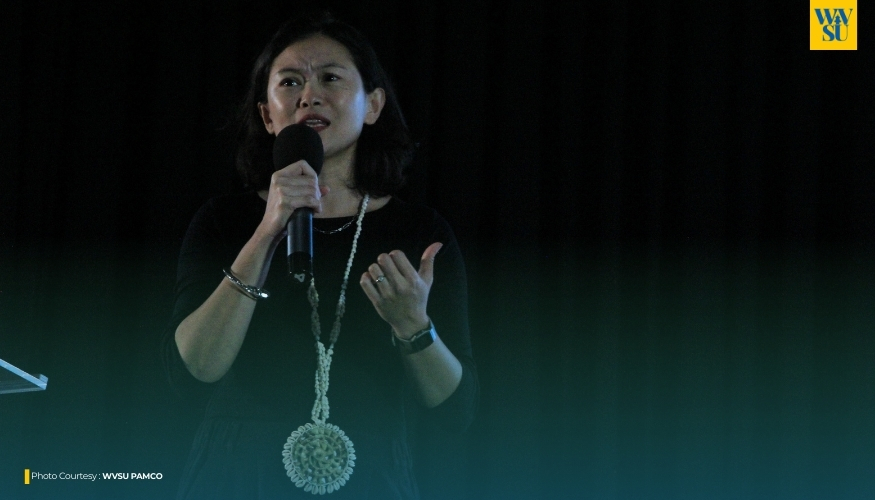
With this message, Pia Ranada, senior journalist and head of community at Rappler, challenged young communicators to rethink their role in an era shaped by algorithms, artificial intelligence and declining public trust.
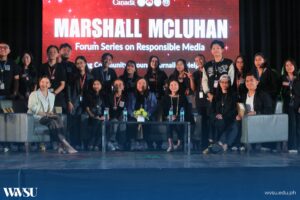
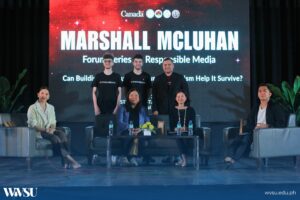
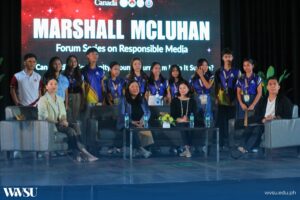
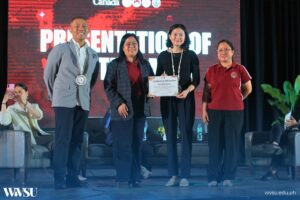
Ranada spoke at the Marshall McLuhan Forum Series on Responsible Media on Friday, Feb. 20, from 8:30 a.m. to noon at the West Visayas State University (WVSU) Cultural Center, addressing about 500 communication students, campus journalists and alumni from various institutions in Western Visayas.
A journalist shaped by press freedom battles
Ranada has more than a decade of experience covering Philippine politics and governance. She rose to national prominence as Rappler’s Malacañang correspondent during the Duterte administration, where she reported extensively on the government’s war on drugs and other key policies. In 2018, she was barred from covering the presidential palace, a move widely criticized by press freedom advocates.
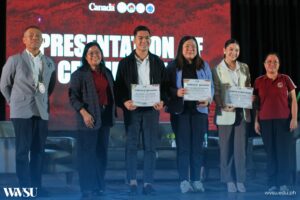
In 2024, she was named the Marshall McLuhan Fellow by the Embassy of Canada in the Philippines, which confers the annual distinction on Filipino journalists recognized for courage, integrity and responsibility. The fellowship includes a study tour in Canada and forms part of a long-running journalism seminar program honoring ethical reporting.
From coverage to community
Drawing from her newsroom experience, Ranada urged students to move “from coverage to community.”
Civic engagement, she said, does not thrive in one-way communication where audiences are passive recipients of information. Instead, it grows through dialogue and collaboration.
“Fostering trust happens when communities know you’ve exhausted all efforts to understand the issue from multiple angles,” Ranada said, underscoring the balance between objectivity and meaningful engagement.
She emphasized that seeking multiple perspectives strengthens — rather than weakens — the pursuit of justice.
“You have to make decisions based on facts and take a stand that these are, indeed, facts — that there are some things that are simply not debatable,” she said in an interview after the forum.
“When we stick to the ethical principle of getting as many sides as possible, that helps foster justice.”
Journalism in the age of AI
The forum also tackled emerging threats to media credibility, including the spread of low-quality AI-generated content, doomscrolling and sensationalism driven by profit.
Ranada warned that algorithms increasingly shape what people read and watch, deepening polarization. But she pointed to solutions: stronger fact-checking efforts, participatory journalism and crowdsourcing — particularly to protect vulnerable sectors such as the elderly from misinformation.
Dr. Rona Dhel C. Alingasa, dean of the WVSU College of Communication, opened the event by highlighting journalism’s evolving role in a rapidly shifting information landscape.
The forum was hosted by the College of Communication’s Broadcast Guild in partnership with the university’s International and Local Linkages Office.
A wake-up call for young journalists
For many student attendees, the discussion was both validation and challenge.
Jasmin Ava Tatoy, a Grade 9 student from Antique Vocational School’s Special Program in Journalism, described the event as a wake-up call.
“It is no longer just about telling stories, but about strengthening the communities we represent,” she said.
Christian John B. Barredo, a third-year Development Communication student, said the session reinforced his commitment to community-centered reporting.
“Centering narratives on people bridges the gap between raw reporting and lived experience,” he said.
The previous Marshall McLuhan Forum in 2023 featured broadcast journalist Karmina Constantino as keynote speaker.
As Ranada reminded the audience, journalism’s future lies not merely in producing more content, but in rebuilding trust.
Because in the end, she said, journalism is not just about stories — it is about connection.