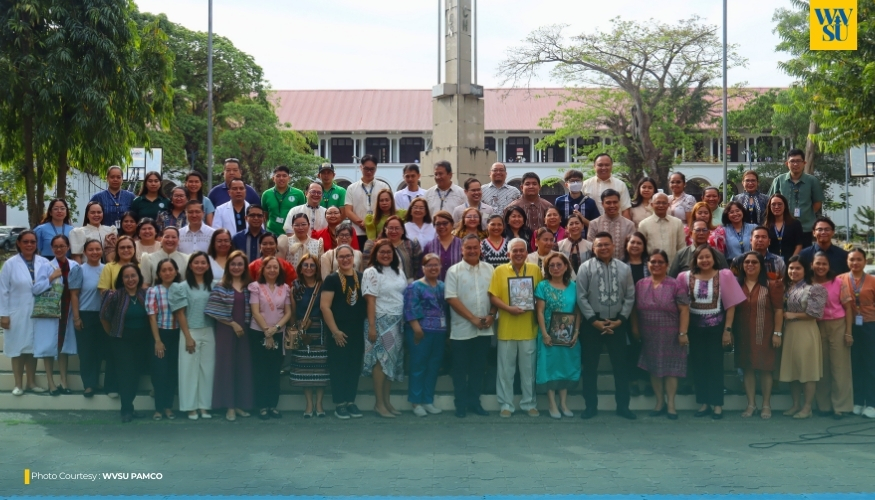
West Visayas State University marked a leadership transition at the College of Medicine (COM), announced key March activities and shared campus updates during its first Monday flag ceremony in March at Jubilee Park.
Dr. Celina Cordero-Gellada officially assumed office as dean of the COM on March 2, succeeding Dr. Victor Amantillo Jr., who completed a four-year term.
The WVSU community formally sent off and honored Amantillo for his service. In his farewell message, he acknowledged the challenges faced during his tenure, particularly amid the pandemic, and thanked faculty, staff and students for their collective efforts in strengthening the college.
“The last four years have not been very easy. It was not always pleasant, but it is very satisfying,” Amantillo said, emphasizing that COM exists primarily to serve its students and the Filipino people.
WVSU President Dr. Joselito Villaruz commended Amantillo’s leadership, noting his role in advancing innovations within the College and steering the COM through the Philippine Accrediting Association of Schools, Colleges and Universities accreditation process toward the end of his term.
Villaruz then introduced Cordero-Gellada as the new COM dean. In her acceptance message, she described the appointment as both a responsibility and a public trust.
“To lead the College of Medicine is not just an appointment; it is a public trust. It is a commitment to the Filipino people, especially to the communities we are sworn to serve,” she said, adding that COM continues to shape physicians who bring both competence and compassion to the practice of medicine.
The flag ceremony also served as a platform for campus-wide announcements relevant to students and employees.
University Registrar Ms. Mardy Ledesma reminded the community that the WVSU Admission Examination will be held March 8, 2026, in three batches: 8 to 10 a.m., 1 to 3 p.m., and 4 to 6 p.m. Students and offices concerned were advised to prepare for possible adjustments in campus traffic and venue use.
The Gender and Development Office formally launched WVSU’s observance of National Women’s Month. Prof. Rosalea Cornelia Araneta-de Leon announced that activities will run throughout March, including Purple Wednesdays and gender sensitivity trainings for freshmen on March 27.
Updates on international engagement were also shared. Prof. Edel Carmela Subong-Csoka, director of the International and Local Linkages Office, introduced Maëlys Bourdin, a French intern who will stay at WVSU until April for an academic and cultural exchange engagement.
The program concluded with performances by WVSU cultural dance groups, who recently won first place in contemporary, indigenous, folk and street dance categories at the Regional Association of State Universities and Colleges VI Culture and the Arts Festival held at the University of Antique from Feb. 20 to 24, 2026.
The flag ceremony was led by faculty and staff of the College of Medicine.
Category: Governance
-
WVSU welcomes new Medicine dean, announces Women’s Month activities and March 8 admission exam
-
CHED RAISE 2026 concludes with AI policy commitment and industry insights
West Visayas State University (WVSU) joined higher education leaders, industry partners, and policymakers as the Commission on Higher Education (CHED) Responding through AI for Societal Empowerment (RAISE) 2026 national summit concluded Feb. 27 at the Iloilo Convention Center.
Mounted by CHED, in partnership with Northern Iloilo State University (NISU) and WVSU, the three-day summit culminated with discussions on democratizing AI skills, strengthening graduate employability, and formalizing a shared commitment to a draft AI policy for education — reinforcing the call for responsible and inclusive artificial intelligence integration across Philippine higher education.
Dr. Randy S. Gamboa of the CHED Technical Panel for Information Systems opened the morning program with welcome remarks and a recap of Day 2, highlighting key insights on workforce readiness and institutional alignment.
Global and industry perspectives followed. Yean Feng Yue, corporate social responsibility head of IBM Asia-Pacific, delivered “Democratizing AI Skills: How IBM Is Helping to Close the Digital Divide,” emphasizing access to AI education and digital inclusion initiatives. David Padgett, founder and chairman of the board of SeeMeSOL, presented “Accelerating Graduate Employability, Advancing National Productivity,” underscoring the role of AI-enabled platforms in improving career pathways and workforce outcomes.
Joan Michelle Dela Paz, talent acquisition manager of TTEC Iloilo, discussed “From Call Centers to AI-Enabled Global Experience Hubs: The Shift in Customer Experience,” highlighting evolving industry expectations and the growing demand for AI-integrated competencies among graduates.
The program also included the awarding of certificates to participating exhibitors from various CHED regional offices and industry partners, recognizing their contributions to the summit’s exhibit component, which remained open to participants throughout the day.
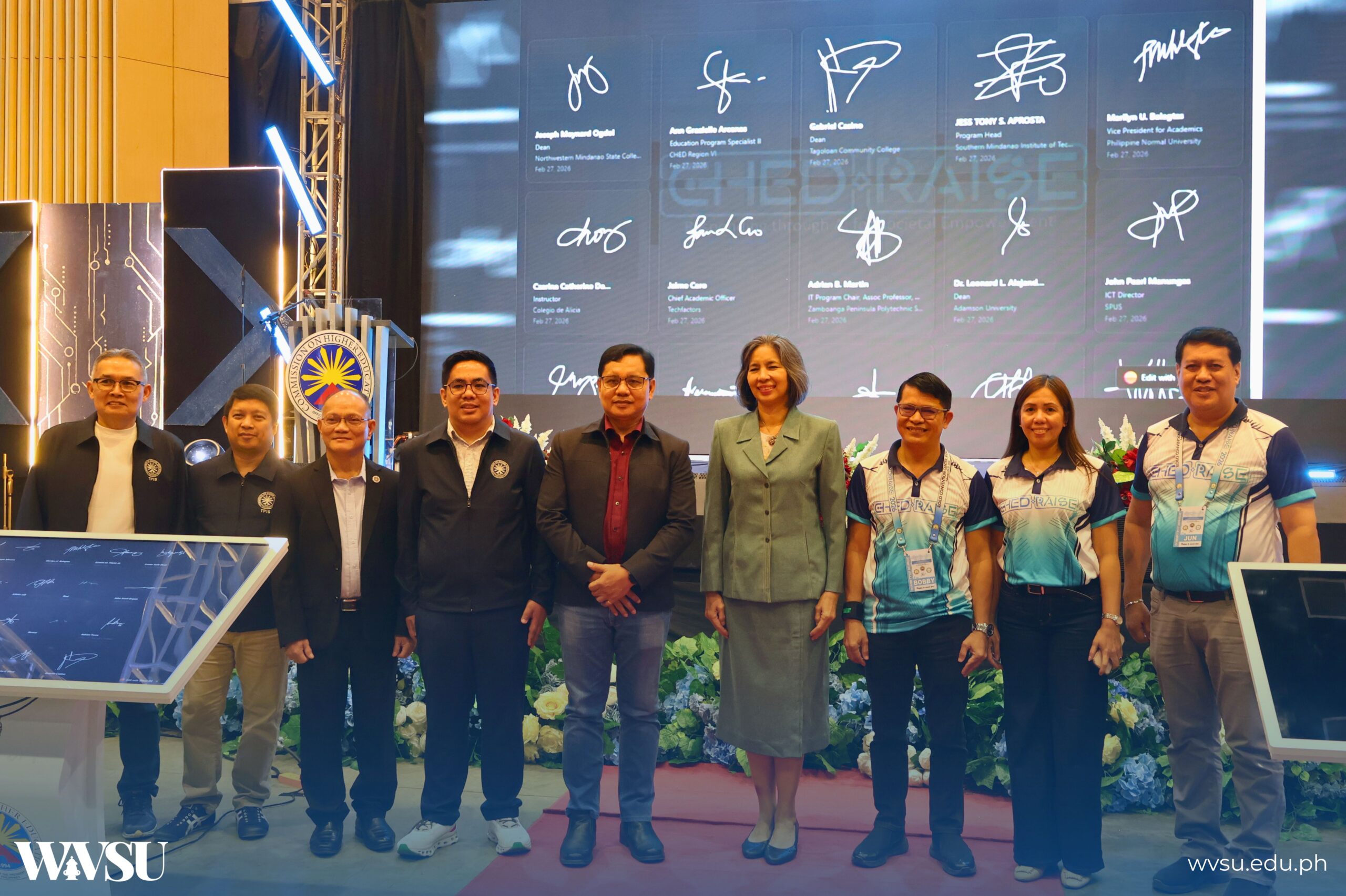
A major highlight of the closing program was the presentation of the Draft AI Policy in Education by Sherwin M. Pelayo, executive director of the Analytics Association of the Philippines. This was followed by a digital commitment signing, with higher education institutions, student representatives, and industry partners formally expressing support for the proposed policy framework.
Dr. Raul F. Muyong, CHED Regional Director for Region VI, delivered the closing remarks, marking the culmination of the three-day summit.
With its role as co-host, WVSU helped convene national and regional stakeholders in shaping policy dialogue, strengthening industry collaboration, and advancing a shared vision for ethical, inclusive, and future-ready AI integration in higher education. -
WVSU president opens Day 2 of CHED RAISE with focus on AI workforce readiness
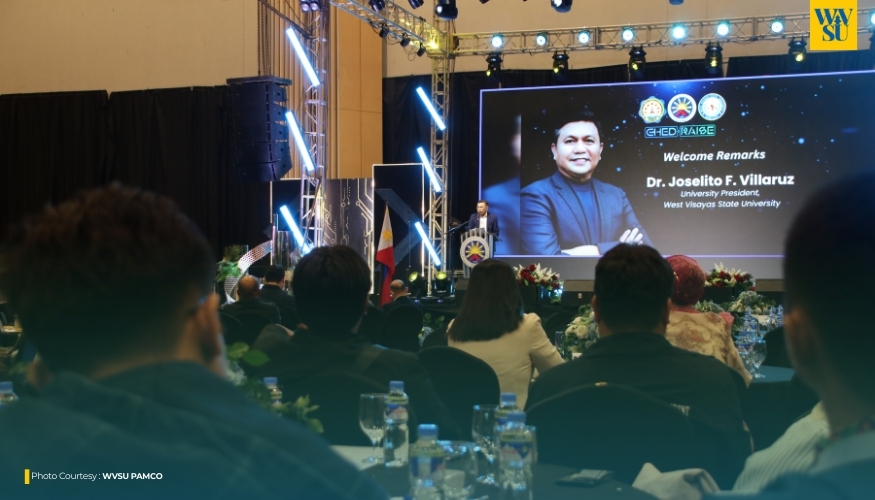
West Visayas State University (WVSU) President Dr. Joselito F. Villaruz opened the second day of the Commission on Higher Education (CHED) Responding through AI for Societal Empowerment (RAISE) 2026 national summit on Feb. 26, reaffirming WVSU’s commitment to responsible and inclusive artificial intelligence in higher education.
Held at the Iloilo Convention Center, the three-day CHED RAISE summit is headed by CHED, in partnership with Northern Iloilo State University (NISU) and WVSU. The event gathers university leaders, faculty members, students and industry partners to align academic programs with the demands of an AI-driven economy.
A key highlight of Day 2 was the plenary discussion “AI Requirements in the Industry,” which examined workforce competencies, infrastructure readiness and cross-sector collaboration needed to meet emerging industry standards. Panelists included Jonathan Defensor De Luzuriaga, president and CEO of Spring Valley Tech Corp.; Engr. Fulbert Woo, president of the Iloilo Chamber of Commerce and Industry; and Frankie Antolin, executive director of the IT and Business Process Association of the Philippines. The discussion was moderated by Jaime Noel Santos, president of Thames International Business School.
The session underscored the urgency of equipping graduates with AI, analytics and digital competencies that respond directly to industry needs — a message that carries direct implications for curriculum development, instruction and student preparation at WVSU.
Parallel breakout sessions provided sector-focused discussions for faculty members, administrators and students.
For teachers, Engr. Orland Tubola of the Polytechnic University of the Philippines led “AI for Cooperatives,” highlighting AI applications in cooperative management and community-based enterprises. In the afternoon, Dr. Jassiel Padios of Iloilo State University of Fisheries Science and Technology, delivered “Capacity Building on Fisheries AI-Mediated Technologies,” emphasizing AI applications in fisheries research and extension. Engr. Lester Phil Crus of Bulacan State University also presented the “Executive Program on Artificial Intelligence and Internet of Things for SUCs and LUCs (BulSU-HUSAY)”, outlining structured capacity-building initiatives for state and local universities and colleges.
For administrators, Samu Samson of International Business Machines Corp. led “Setting Up the Infrastructure for an AI Program,” focusing on institutional readiness and scalable implementation. Dr. Oliver Malabanan of De La Salle University discussed “Designing Curricula Aligned with the Philippine Skills Framework for Analytics and AI,” emphasizing outcomes-based alignment with national standards. Dr. Jaime D.L. Caro of Technofactors Inc. delivered “Developing a Research Agenda in the Age of Artificial Intelligence,” centering on strategic research planning responsive to emerging AI developments.
Students attended “Automating Intelligence: The Power of RAG in Document Processing,” presented by Dr. Gregg Victor Gabison, country manager of Raybiz Technologies Inc., which explored retrieval-augmented generation and its practical applications. Malt John Vianney Solon, a senior computer science student of Cebu Institute of Technology University, led “Machine Learning Made Simple,” translating foundational machine learning concepts into practical, real-world applications. Another session, “AI-Powered Career Services for Improved Graduate Employability,” was delivered by David Padgett of SeeMeSOL, highlighting AI-driven platforms designed to enhance career guidance, skills matching and employment pathways.
As the summit enters its final day, WVSU continues to play an active role in convening academic and industry leaders, strengthening policy dialogue and advancing the responsible and inclusive integration of AI across Philippine higher education. -
WVSU co-hosts CHED RAISE 2026 national summit on responsible AI
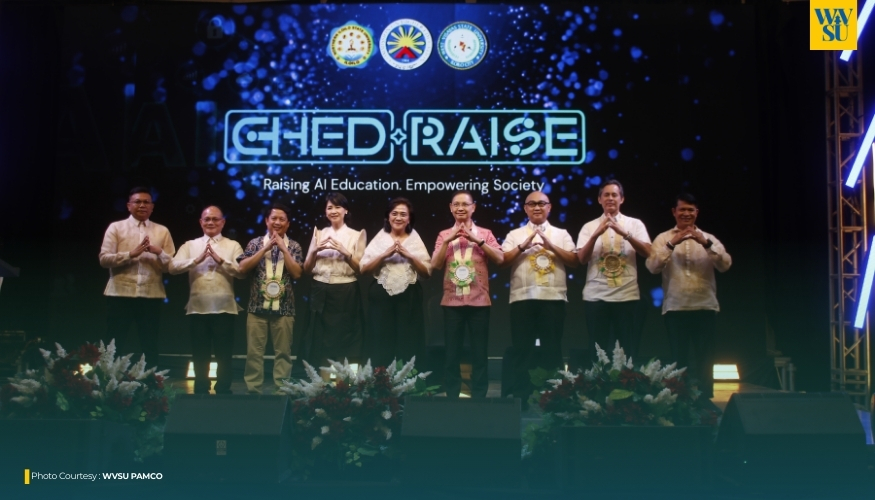
West Visayas State University (WVSU) is co-hosting the three-day CHED Responding through AI for Societal Empowerment (RAISE) 2026 national summit, which opened Feb. 25 at the Iloilo Convention Center and brings together higher education leaders, policymakers, industry partners and students from across the country.
Mounted by the Commission on Higher Education (CHED), in partnership with Northern Iloilo State University (NISU) and WVSU, the summit centers on the theme “Empowering Minds, Transforming Communities through Responsible and Inclusive AI.” The gathering highlights how artificial intelligence can be integrated responsibly into teaching, learning and institutional governance.
For the WVSU community, the summit positions the University at the forefront of national conversations on AI policy, workforce readiness and innovation in higher education.
A key highlight of the opening plenary was the presentation of the National AI Upskilling Roadmap: Building a Competitive National AI Workforce, identified as a “Big Bet for the Future” under the National Education and Workforce Development Plan 2026–2028. Sherwin M. Pelayo, executive director of the Analytics Association of the Philippines, presented the roadmap and moderated a fireside chat on AI in basic education, higher education and lifelong learning.
The panel included CHED Chairperson Dr. Shirley C. Agrupis; CHED Undersecretary for Strategic Management Dr. Ronald Mendoza; Technical Education and Skills Development Authority Director General Jose Francisco “Kiko” B. Benitez; Private Sector Advisory Council Chairperson Alfredo Antonio Ayala; and Analytics Association of the Philippines President and Co-founder Michelle Alarcon. Discussions focused on strengthening collaboration between government and industry to ensure AI adoption in education remains responsible, inclusive and aligned with national development goals.
The opening program also featured the ceremonial turnover of the CHEDx 2024 Coffee Table Book and a digital ribbon-cutting of exhibition booths, followed by an exhibit tour and media briefing on CHED’s AI initiatives and policy directions for higher education institutions.
Participants later joined parallel breakout sessions tailored to administrators, faculty and students.
University leaders convened for a Presidents’ Forum titled “Crafting an AI Policy for Higher Education,” aimed at developing a cohesive framework for responsible AI integration across Philippine higher education institutions.
For educators and administrators, Asst. Prof. John Richard M. Esguerra of Batangas State University led a session on data science and cybersecurity, emphasizing data literacy and cyber resilience in academic institutions. Another session delivered by Mark Benlor Sy of National Teachers College explored AI-enabled learning design and delivery, focusing on integrating analytics and AI tools into curriculum development and assessment.
Students attended “Think Before You Prompt: A Framework for Responsible AI-Supported Learning,” delivered by Dr. Dave E. Marcial of Silliman University, which underscored the ethical and critical use of AI in academic work. A separate session by Dr. Ace Lagman of FEU Institute of Technology introduced core concepts and applications of artificial intelligence, machine learning and deep learning.
The summit runs until Feb. 27, reinforcing WVSU’s role as an active partner in shaping national policy and practice on ethical and inclusive AI in education. -
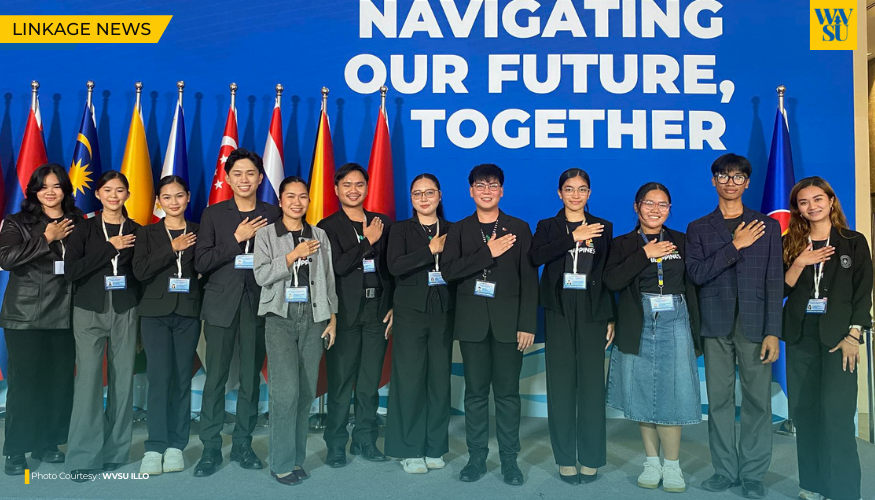
WVSU demonstrates global service excellence at 49th High-Level Task Force on ASEAN Economic Integration
West Visayas State University (WVSU), through its Tourism students, DagYoung Student Ambassadors, and the International and Local Linkages Office, has taken on the role of Information Officers as Iloilo hosts the 49th High-Level Task Force on ASEAN Economic Integration (HLTF-EI), which gathers high-ranking economic officials from ASEAN Member States, from February 25–28, 2026, in support of the Philippines’ hosting of the event.
Working alongside the Department of Tourism (DOT) Region VI, WVSU personnel and student volunteers are assisting in the operation of information desks at official meeting locations and delegate accommodations, helping ensure smooth coordination and a warm welcome for ASEAN officials and participants.
This initiative supports the DOT Region VI in its leadership of the Committee on Tourism, Hospitality, Tours, Social Events, and Site Enhancement (CHTSESE), which plays a vital role in enhancing delegate services during ASEAN Senior Officials’ and Ministerial Meetings.
Aligned with the Philippines’ ASEAN Chairmanship priorities — including digital economy cooperation, economic security, and expanded trade partnerships — WVSU’s participation reflects its commitment to service excellence.
This engagement also builds on the participants’ completion of the Filipino Brand of Service Excellence training last February 6, equipping them to deliver globally competitive Filipino hospitality to international delegates.
By Gladwyn B. Gustilo/ILLO -
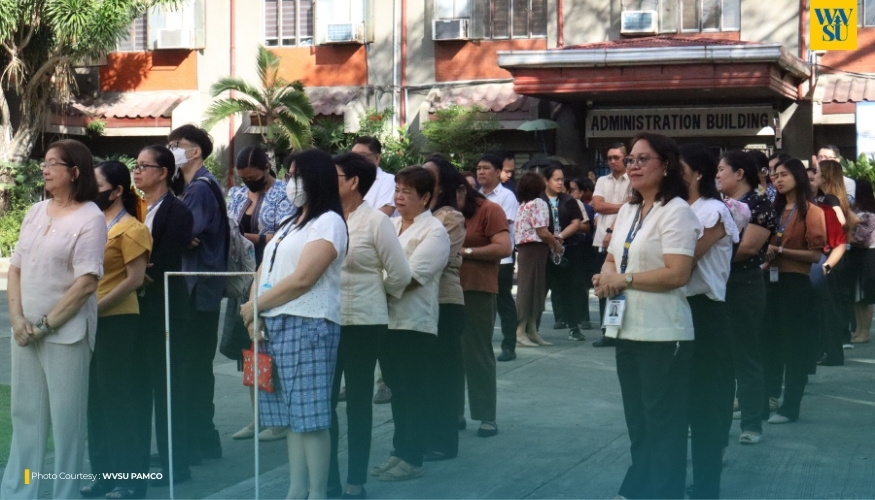
WVSU prepares for March 8 admission exam as applicants reach up to 15,000
West Visayas State University (WVSU) is preparing for one of its largest admission examinations in recent years, with about 14,000 to 15,000 applicants expected to take the WVSU Admission Examination (WVSU AE) on March 8, 2026.
The update was announced during the University’s Feb. 23 flag-raising ceremony at Jubilee Park, led by the Registrar’s Office headed by Ms. Mardy Ledesma.
Ledesma said examination permits are currently being sent to applicants through their registered email addresses, with distribution continuing until Feb. 27. She added that a call for faculty and staff members who wish to serve as proctors will be issued within the week, as the University mobilizes personnel to accommodate the large number of examinees.
The ceremony also highlighted upcoming international engagements. Prof. Edel Carmela Subong-Csoka, director of the International and Local Linkages Office, announced that additional French students and a professor from Belgium are expected to participate in forthcoming academic and cultural exchange activities at WVSU. She also introduced Ms. Eugenie Moret, a French graduate student who will undertake a two-month exchange program at the University.
Moret, who is completing a master’s degree specializing in teaching abroad, shared her aspirations for the exchange. “During my time here, I hope to better understand Filipino cultural values, multilingual practices and how knowledge circulates in this context,” she said.
The final flag-raising ceremony for February underscored both the University’s preparations for the upcoming admission cycle and its continuing international partnerships. -
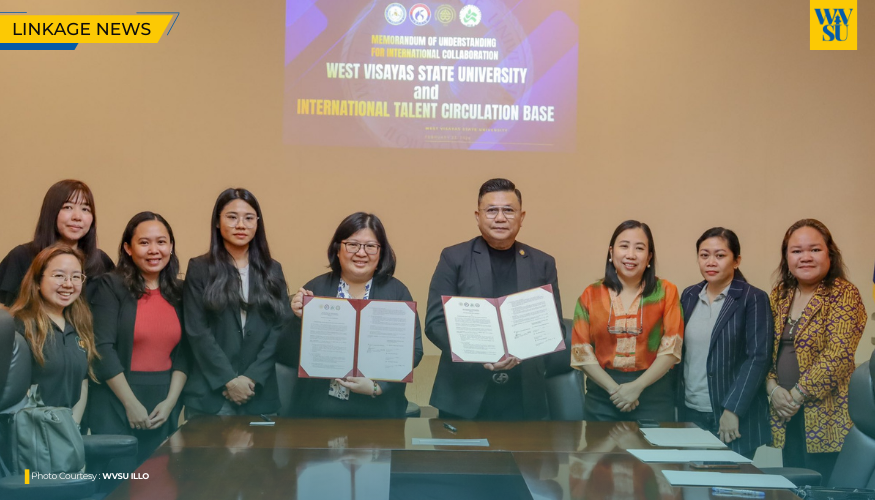
WVSU signs MOU with Taiwan-Based INTACT to boost global education opportunities
On February 23, West Visayas State University (WVSU) entered into a Memorandum of Understanding with the International Talent Circulation Base (INTACT Base), a collaborative initiative composed of National Chung Hsing University, Kun Shan University, and Cheng Shiu University, to strengthen international academic collaboration and expand opportunities for Filipino students to pursue higher education in Taiwan.
Representing the INTACT Base Taiwan-Philippines Iloilo Office were Ms. Krystl Lim, Deputy CEO; Ms. Lisa Huang, Project Manager; Ms. Michelle Diongco, Mandarin Teacher; and Ms. Cherisse Hope Gomez, Project Director.
WVSU President Dr. Joselito F. Villaruz emphasized the significance of the partnership in advancing the University’s mission of global engagement and talent development.
This commitment was echoed by Dr. Ma. Corazon M. Samorin, OIC Campus Administrator of WVSU Janiuay Campus, highlighting the campus’ support for international learning opportunities.
Through this agreement, both parties aim to support WVSU students who wish to continue their studies in Taiwan through the International Industrial Talents Education Special Program (INTENSE Program), which offers two years of advanced training under post-baccalaureate or master’s degree programs in Taiwanese universities, while also promoting Chinese language education and broader academic exchange.
By Gladwyn B. Gustilo/ILLO -
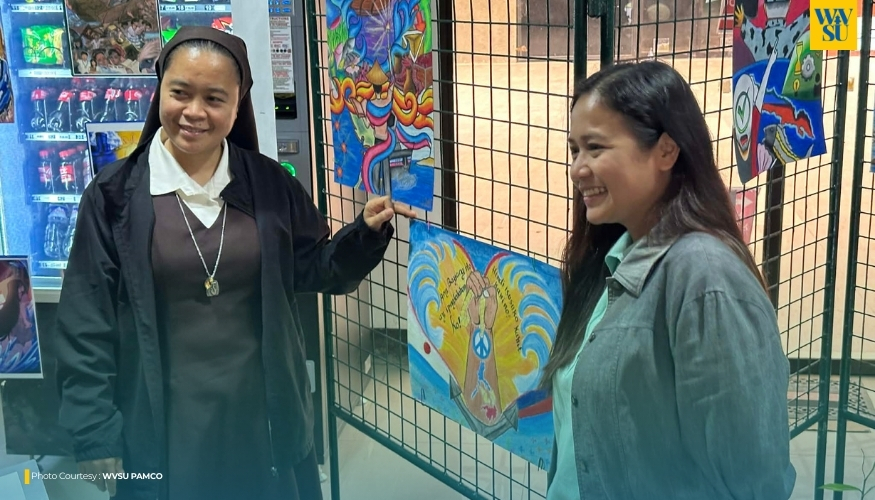
WVSU opens ‘Pag-amlig’ Peace Art Exhibit on West Philippine Sea
West Visayas State University opened the weeklong “Pag-amlig” Peace Art Exhibit on Feb. 21 at the Administration Building, featuring student artworks that call for the protection of the West Philippine Sea and affirm the role of the youth in safeguarding national sovereignty.
The exhibit showcases 13 posters created following a Feb. 14 forum on maritime awareness and national security. Through visual art, students translated dialogue into advocacy, expressing themes of patriotism, unity, environmental stewardship and responsible citizenship.
The forum gathered students from NSTP–CWTS, ROTC and the College of Education Graduate School for discussions on maritime security, sustainability and the responsibility of Filipino youth to remain informed and engaged in issues that affect the nation’s territorial integrity.
Organizers said the initiative sought to move conversations beyond the classroom by providing a platform for students to articulate their convictions and participate in nation-building through creative expression.
The program was organized by the National Task Force for the West Philippine Sea in collaboration with the University’s International and Local Linkages Office, Office of the University President, NSTP–CWTS and ROTC, and the Center for Peace Education, underscoring the value of partnership in promoting informed discourse and active citizenship.
The exhibit runs for one week. Members of the University community are encouraged to visit and reflect on the students’ messages of peace, responsibility and national solidarity. -
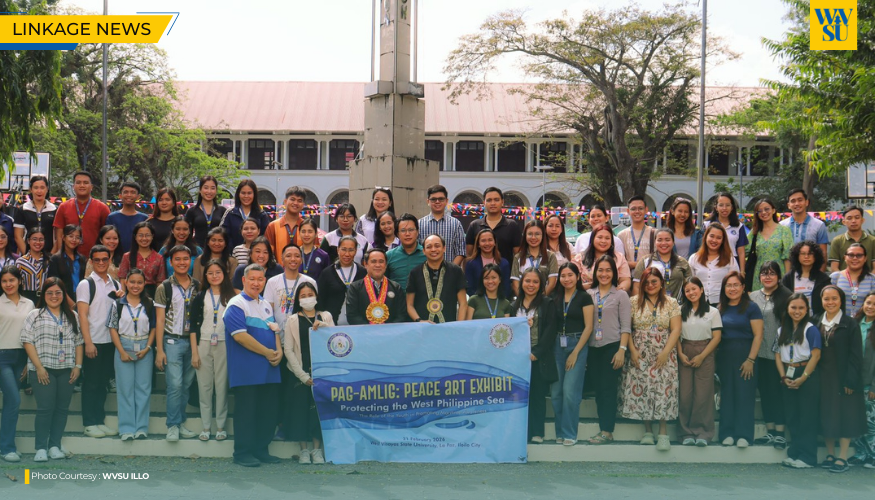
“Pag-amlig” exhibit brings colors of advocacy to the West PH Sea at WVSU
Brushstrokes became voices and canvases turned into calls for action as West Visayas State University unveiled the weeklong “Pag-amlig” Peace Art Exhibit on February 21 at its Administration Building.
Thirteen compelling posters line the university halls, each echoing a shared conviction: safeguarding the West Philippine Sea belongs not only in policy discussions, but also in the hearts of an informed and engaged generation.
Rooted in the February 14 forum on maritime awareness and national security, the artworks reflect students’ insights translated into purposeful design by participants from NSTP–CWTS, ROTC, and the College of Education Graduate School.
The initiative came to life through the collective efforts of the National Task Force for the West Philippine Sea, the International and Local Linkages Office, the Office of the University President, NSTP, the University Library, and the Center for Peace Education.
By Gladwyn B. Gustilo/ILLO -
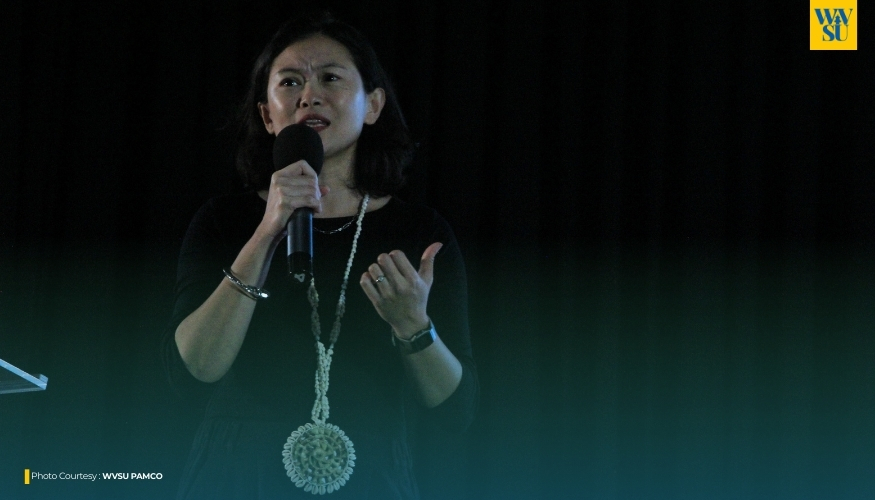
McLuhan fellow Pia Ranada urges journalists to build communities, not just headlines at university media forum
“The heart of journalism is connection.”
With this message, Pia Ranada, senior journalist and head of community at Rappler, challenged young communicators to rethink their role in an era shaped by algorithms, artificial intelligence and declining public trust.
Ranada spoke at the Marshall McLuhan Forum Series on Responsible Media on Friday, Feb. 20, from 8:30 a.m. to noon at the West Visayas State University (WVSU) Cultural Center, addressing about 500 communication students, campus journalists and alumni from various institutions in Western Visayas.
A journalist shaped by press freedom battles
Ranada has more than a decade of experience covering Philippine politics and governance. She rose to national prominence as Rappler’s Malacañang correspondent during the Duterte administration, where she reported extensively on the government’s war on drugs and other key policies. In 2018, she was barred from covering the presidential palace, a move widely criticized by press freedom advocates.
In 2024, she was named the Marshall McLuhan Fellow by the Embassy of Canada in the Philippines, which confers the annual distinction on Filipino journalists recognized for courage, integrity and responsibility. The fellowship includes a study tour in Canada and forms part of a long-running journalism seminar program honoring ethical reporting.
From coverage to community
Drawing from her newsroom experience, Ranada urged students to move “from coverage to community.”
Civic engagement, she said, does not thrive in one-way communication where audiences are passive recipients of information. Instead, it grows through dialogue and collaboration.
“Fostering trust happens when communities know you’ve exhausted all efforts to understand the issue from multiple angles,” Ranada said, underscoring the balance between objectivity and meaningful engagement.
She emphasized that seeking multiple perspectives strengthens — rather than weakens — the pursuit of justice.
“You have to make decisions based on facts and take a stand that these are, indeed, facts — that there are some things that are simply not debatable,” she said in an interview after the forum.
“When we stick to the ethical principle of getting as many sides as possible, that helps foster justice.”
Journalism in the age of AI
The forum also tackled emerging threats to media credibility, including the spread of low-quality AI-generated content, doomscrolling and sensationalism driven by profit.
Ranada warned that algorithms increasingly shape what people read and watch, deepening polarization. But she pointed to solutions: stronger fact-checking efforts, participatory journalism and crowdsourcing — particularly to protect vulnerable sectors such as the elderly from misinformation.
Dr. Rona Dhel C. Alingasa, dean of the WVSU College of Communication, opened the event by highlighting journalism’s evolving role in a rapidly shifting information landscape.
The forum was hosted by the College of Communication’s Broadcast Guild in partnership with the university’s International and Local Linkages Office.
A wake-up call for young journalists
For many student attendees, the discussion was both validation and challenge.
Jasmin Ava Tatoy, a Grade 9 student from Antique Vocational School’s Special Program in Journalism, described the event as a wake-up call.
“It is no longer just about telling stories, but about strengthening the communities we represent,” she said.
Christian John B. Barredo, a third-year Development Communication student, said the session reinforced his commitment to community-centered reporting.
“Centering narratives on people bridges the gap between raw reporting and lived experience,” he said.
The previous Marshall McLuhan Forum in 2023 featured broadcast journalist Karmina Constantino as keynote speaker.
As Ranada reminded the audience, journalism’s future lies not merely in producing more content, but in rebuilding trust.
Because in the end, she said, journalism is not just about stories — it is about connection.