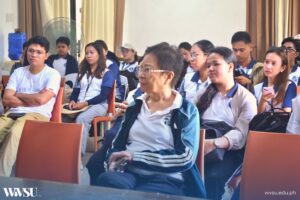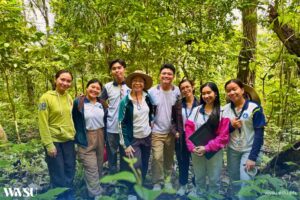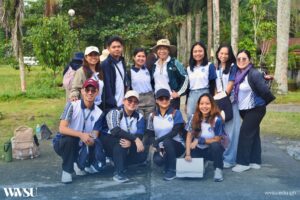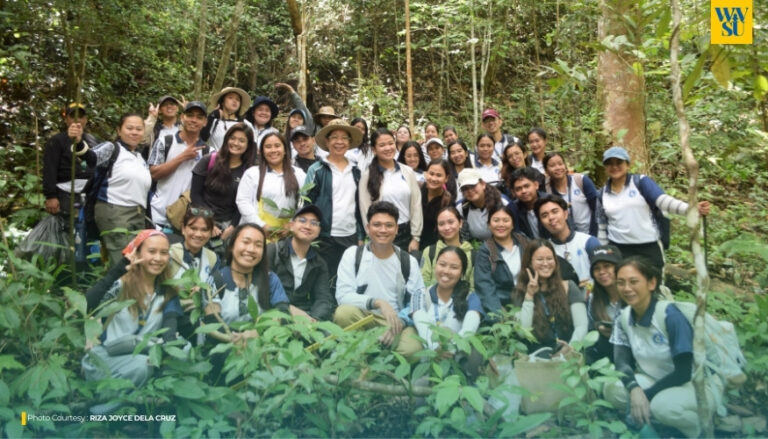
Graduate students from the Master of Arts in Education (MAEd) majoring in Biological Sciences at West Visayas State University (WVSU) Main Campus conducted a field-based ecological assessment at Mari-it Wildlife and Conservation Park on Mar. 14, 2026. The activity was part of the course BSC 503: Advanced Ecology and was supervised by Dr. Josette T. Biyo.
The field study covered population sampling, vegetation analysis, and ecosystem dynamics, giving students practical experience in ecological research methods within a protected forest ecosystem. About 40 graduate students took part in the activity.
Dr. Biyo emphasized the value of place-based and inquiry-driven learning in science education, highlighting that hands-on field experiences help link abstract ecological ideas with real-world environmental issues. She observed that experiential learning improves teachers’ practical scientific literacy and promotes active involvement in citizen science and environmental stewardship.
“What you have learned in the classroom and what you have concretized in activities can truly be taught to your learners as well. That’s very important for conservation and appreciation. This will help teach kids and the community how to care for our forests, which serve as habitats for wildlife,” she said.
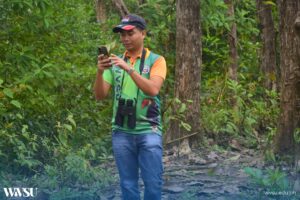
The field activity was carried out in partnership with the WVSU College of Agriculture and Forestry (CAF), led by Dr. Jose Ariel A. Tutor. Foresters and volunteers from CAF accompanied the graduate students during the fieldwork, offering technical guidance in species identification, vegetation analysis, and ecological data collection.
During the assessment, students used systematic sampling techniques, specifically transect and quadrat methods, to conduct inventories of mature trees, saplings, shrubs, and seedlings, as well as to identify tree species composition and associated organisms. These methods enabled participants to examine species distribution, characterize vegetation structure, and explore ecological interactions within the forest ecosystem.
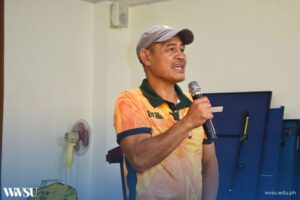
Forester Rod Reynan Laspiñas emphasized the importance of practical field experience in understanding ecological concepts.
“It’s very important for you to visit the site because it helps you better understand the concepts of vegetation analysis and forest ecology overall. This is what we call action-oriented learning or learning by doing. The experience is very different when you are right there on the ground,” he explained.
The Mari-it Wildlife and Conservation Park, situated within the 3,000-hectare WVSU Lambunao Campus, serves as a sanctuary for several endemic wildlife species. These include the Visayan warty pig (Sus cebifrons), the Visayan tarictic hornbill (Penelopides panini), and the Visayan leopard cat (Prionailurus javanensis), locally known as Maral, which also symbolizes the university.
As a recognized center for wildlife conservation and biodiversity protection in Western Visayas, the park functions as an ideal living laboratory for ecological research and environmental education. The field activities thus support the broader institutional efforts of WVSU to equip future educators with advanced ecological research skills while fostering a deeper appreciation for biodiversity conservation and sustainable ecosystem management.