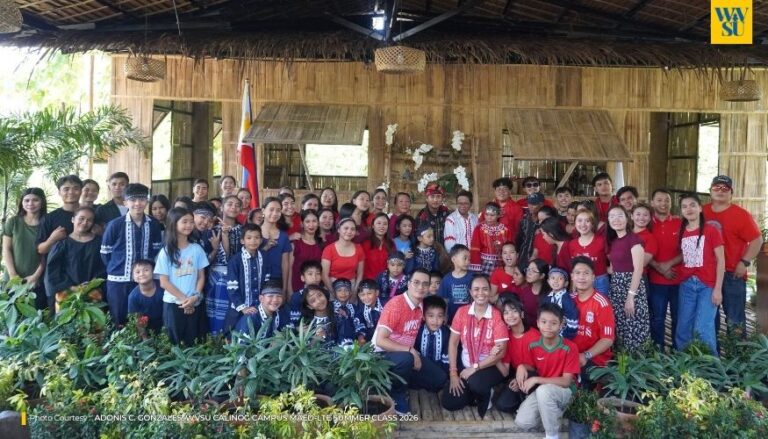
Thirty-three graduate students from the West Visayas State University (WVSU) Calinog Campus strengthened their understanding of culturally responsive language education through a community immersion with the Panay Bukidnon in Tapaz, Capiz, demonstrating how experiential learning can bridge academic theory with Indigenous knowledge and cultural preservation.
The students, enrolled in the Master of Arts in Education, Major in Language Teaching-English (MAEd-LTE) Summer Class 2026, participated in “Pamadbad: A Cultural Immersion and Storytelling Program” on July 19 at The Harimuyngan nga Turun-an Academy, Inc. (HTAI).
The activity formed part of the graduate courses LNG 514: Cross-Cultural Communication and LNG 518: Psychology of the Reading Process, providing future language educators with opportunities to engage directly with Indigenous learners, cultural practitioners and community elders. Through the immersion, the students gained firsthand experience in applying culturally responsive teaching strategies beyond the traditional classroom.
The initiative reflects WVSU’s commitment to transformative education that values diversity, strengthens community partnerships and promotes inclusive learning. It also supports the United Nations Sustainable Development Goals, particularly SDG 4 (Quality Education) by promoting equitable and culturally relevant education, SDG 10 (Reduced Inequalities) by recognizing Indigenous voices in learning, and SDG 11 (Sustainable Cities and Communities) through the preservation and appreciation of cultural heritage.
One of the program’s highlights was a series of storytelling sessions conducted by the graduate students for HTAI learners. Before the immersion, the students developed instructional materials incorporating Indigenous narratives, local traditions and contextualized learning experiences to make literacy instruction more meaningful and culturally relevant.
Using storybooks, visual aids and interactive reading activities, the graduate students facilitated lessons that enhanced reading comprehension, oral communication and creativity while allowing learners to see their own identities and experiences reflected in the learning process. The activity demonstrated how language education becomes more engaging when it is rooted in the culture and lived experiences of the community.
The immersion also introduced participants to the living heritage of the Panay Bukidnon through conversations and cultural demonstrations led by young cultural master Rennel Lavilla together with Panay Bukidnon cultural masters and community elders.
Students observed traditional performances featuring the subing, a bamboo mouth harp; the agong, a suspended gong; and the tambol, a drum crafted from the skin of the Visayan spotted deer. The cultural bearers also performed the Binanog, a dance that imitates the movements of the hawk, and shared chants from the Sugidanon, including the epic of Labaw Donggon, one of the country’s most treasured oral literary traditions.
The exchange allowed participants to appreciate how language, oral literature, music and performance remain central to preserving Indigenous identity and passing cultural knowledge from one generation to the next.
The program was further enriched by performances from the Padang Sibagun Chorale and HTAI learners, who showcased Ilonggo folk songs and Indigenous cultural presentations that highlighted the vitality of Panay Bukidnon traditions among today’s youth.
Beyond storytelling and cultural performances, the WVSU graduate students immersed themselves in the community’s culinary traditions. Guided by local cultural bearers, they learned the preparation of bayi-bayi, a Visayan delicacy made from pounded young glutinous rice, grated coconut and muscovado sugar using traditional tools. They also observed the preparation of binakol nga manok sa kawayan and the traditional extraction of sugarcane juice, gaining a deeper appreciation of Indigenous knowledge systems and sustainable food practices.
The immersion concluded with a communal meal featuring native dishes prepared at Harimuyngan nga Padapunan, reinforcing the role of food as an expression of cultural identity, history and community.
The program was made possible through the support of the WVSU Calinog Campus administration, the Local Government Unit of Calinog and the College of Education Graduate School. Participants also expressed their gratitude to Dr. Ronilo G. Berondo, president of The Harimuyngan nga Turun-an Academy, Inc., the HTAI learners and the Panay Bukidnon community for sharing their traditions, knowledge and hospitality.
The cultural immersion was led by Dr. Marie Candy L. Celeste, director of Academic Affairs, Indigenous Peoples Education coordinator and facilitator of LNG 514, together with Mr. Adonis C. Gonzales, facilitator of LNG 518.
For the graduate students, the experience underscored that effective language education extends beyond textbooks and lecture halls. By engaging directly with Indigenous communities, they gained a deeper appreciation of the relationship between language, culture and identity while strengthening their commitment to becoming educators who foster inclusive, culturally responsive and community-centered learning.
As WVSU continues to champion experiential learning, initiatives such as “Pamadbad” demonstrate how higher education can empower future educators to preserve cultural heritage, promote inclusive education and build stronger partnerships with communities, advancing the University’s mission of developing lifelong learners and agents of societal transformation.